
An investor researches a company carefully, then doubles the planned purchase after hearing a friend’s success story. The extra purchase was not part of the research. It came from the pressure to keep up. Knowledge and a consistent decision process are different things.
What behavioural finance studies
Behavioural finance looks at how emotions, habits and mental shortcuts affect financial choices. A shortcut can save time, but it can also make us ignore a risk or give weak evidence too much weight. Education does not automatically remove these tendencies.
Success in one area can make a new area feel familiar. Someone who is good at their work may become too confident about choosing shares or predicting prices. A strong ability to explain a decision can also make it easier to defend a poor one.
Expertise does not remove risk
In 1998, the hedge fund Long-Term Capital Management nearly failed. Fourteen banks and brokerage firms invested about US$3.6 billion in a private rescue arranged with help from the Federal Reserve. The Fed did not provide its own money. The episode shows that sophisticated methods and experienced people can still face severe financial risk.
Check common pressures
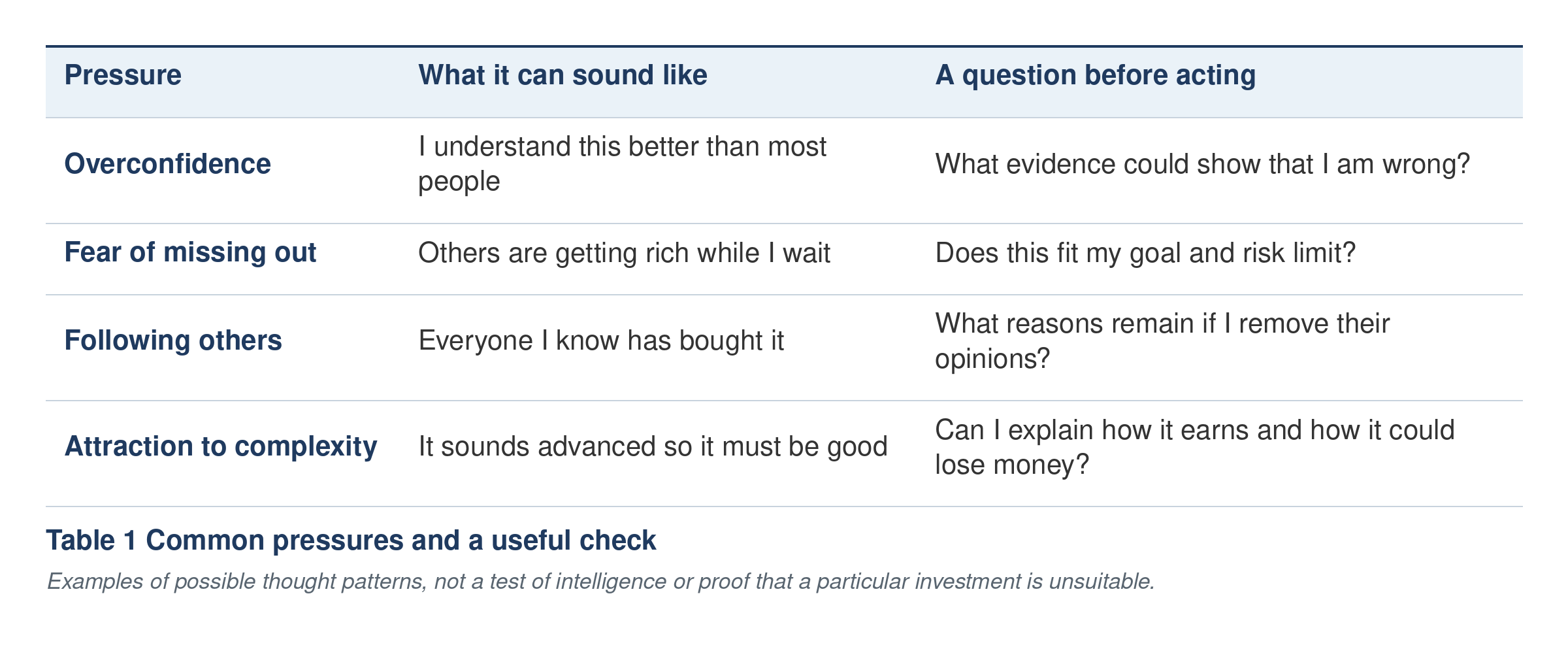 Read statistics without inventing motives
According to SEBI studies released in August 2026, about 88% of individual traders lost money in equity futures and options (F&O) trading during FY 2025–26. Futures and options are contracts whose value depends on an underlying asset or index. The finding concerns trading activity and period; it does not describe all investors.
The study does not establish the traders’ intelligence or prove that one emotion caused every loss. It is a reason to examine the risks of the activity, rather than assume confidence or an impressive explanation is enough.
Make the process easier to follow
Write the goal, amount and risks before acting. Leave time to check an unexpected tip. Automation can help with regular saving, but it does not make an unsuitable investment suitable. Also use an appropriate allocation and spread risk across suitable holdings.
When reviewing a decision, ask whether you followed a sound process with the information available. A good result alone does not prove that the decision was well judged.