
Vikram has ₹10,000 a month available after essential spending and reserves. He can pay extra towards his home loan or invest it. A useful comparison needs the same monthly outflow and a clear set of assumptions.
What prepayment changes
An extra payment reduces the principal on which future interest is charged. Ask the lender to apply it as principal prepayment and show the revised schedule. Keeping the monthly instalment, or EMI, unchanged usually shortens the loan and saves more interest than reducing the EMI.
The saving follows the loan’s actual future rate. It is not a separate investment earning a guaranteed fixed return. A floating rate can change, prepayment charges may apply to some loans, and a lost tax deduction can reduce the net benefit.
Keep both choices on the same budget
Assume a ₹50 lakh loan at a constant 8.5% for 20 years, with an EMI of about ₹43,391. Vikram commits about ₹53,391 a month in either plan.
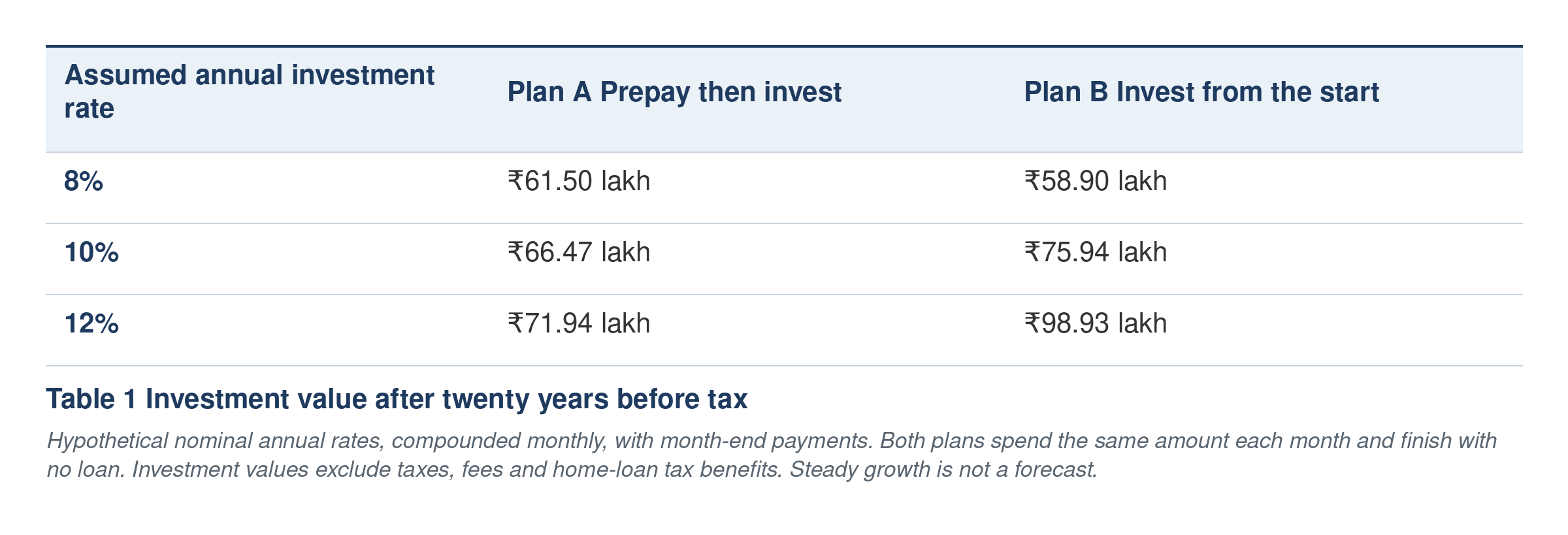
Plan A pays the EMI plus ₹10,000 until the loan ends in month 155, or 12 years and 11 months. It then invests the free payment. Any unused money in the final loan-payment month is invested too. Plan B pays the normal EMI and invests ₹10,000 every month for 20 years.
 Read the comparison with its limits
In this model, paying ₹10,000 extra saves about ₹21.79 lakh of loan interest. Investing from the start finishes ahead at the assumed 10% and 12% rates, but behind at 8%. These results change with returns, repayment timing, fees and tax.
Real market returns arrive unevenly and can include losses. Check the tax on the investment and the home-loan deduction you actually receive. A deduction reduces taxable income; it does not refund the whole interest payment.
Keep access and other debts in view
Do not use money needed for emergencies or near-term bills simply to reduce a long loan. Prepaid money is usually difficult to access again. Investments also differ in liquidity and can lose value when you need to sell.
Check expensive debts before comparing a home loan with investing. For covered floating-rate loans to individuals for non-business purposes, sanctioned or renewed from 1 January 2026, RBI rules prohibit prepayment charges and minimum lock-ins. Older loans may also have protection under earlier rules. Verify which rule covers yours.
A split between prepayment and suitable investing can fit some households. The decision should follow your cash needs and ability to bear risk, rather than one assumed return.