
Suppose a flat costs ₹1 crore and a similar home rents for ₹25,000 a month. Both give you a place to live. Buying builds ownership, while renting leaves more money available for other uses. A useful comparison must account for that money.
Count the cash needed at the start
Assume a ₹20 lakh down payment, ₹7 lakh for stamp duty and registration, and ₹1 lakh for legal and brokerage costs. That is ₹28 lakh upfront. These are example costs; state charges, property type and individual transactions differ.
The remaining ₹80 lakh is borrowed for twenty years at a constant assumed 8.5%. The monthly instalment, or EMI, is about ₹69,426. Add ₹5,000 a month for the owner’s upkeep and property costs. The example assumes the renter’s ₹25,000 already covers their ordinary upkeep.
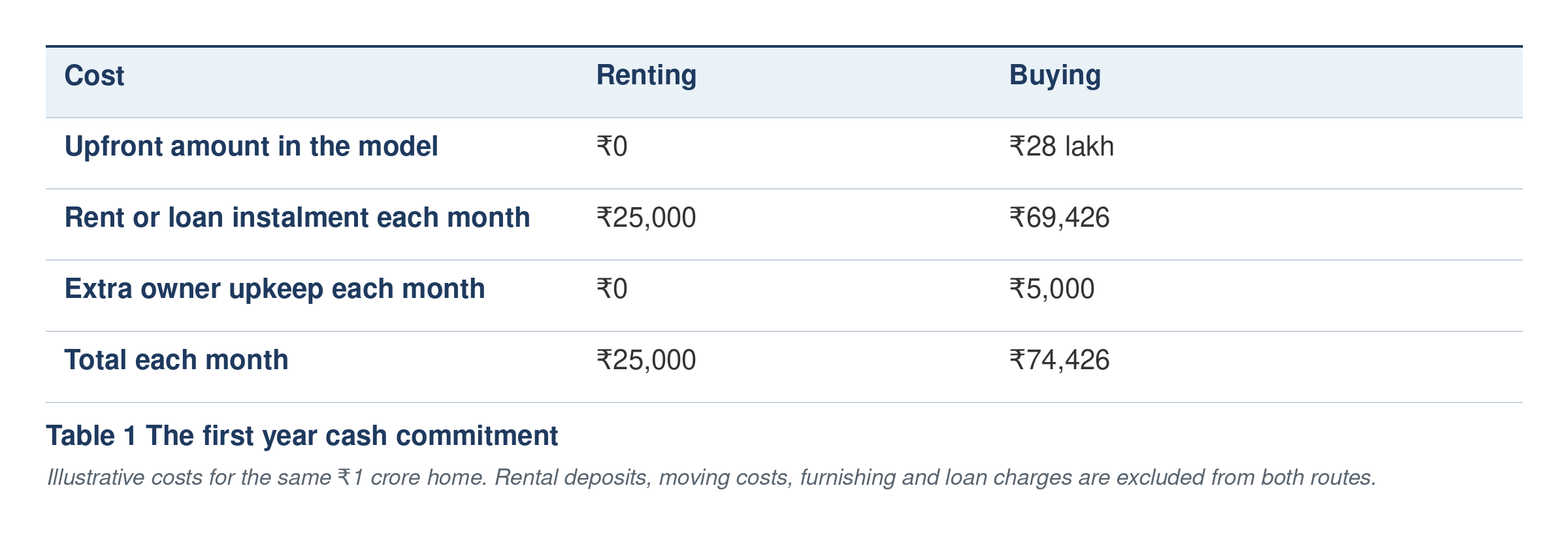 The loan payments total about ₹1.67 crore over twenty years. About ₹6.74 lakh of the first year’s payments is interest. Only the principal part reduces what you owe.
Compare what each household owns later
Assume both households can afford the same cash outflow. The renter invests the ₹28 lakh at the start and invests the monthly difference between buying and renting. Rent and owner upkeep rise 5% after every twelve months. The EMI stays unchanged. Investments grow at an assumed 9% annual rate divided by twelve each month.
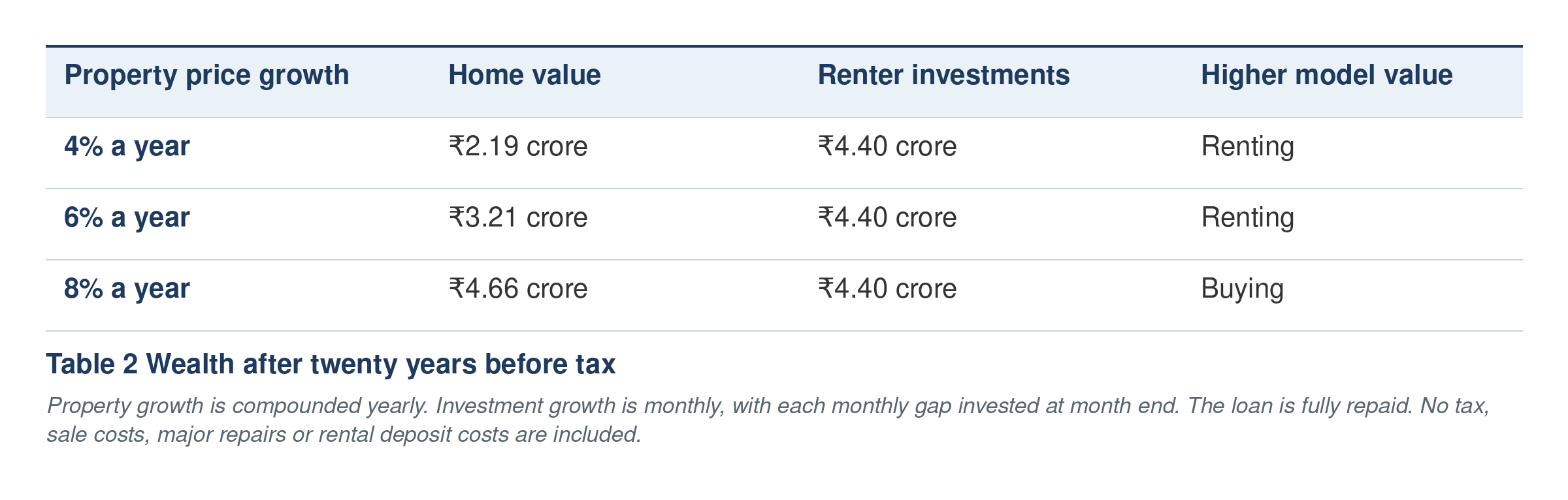 The break-even property growth is about 7.69% a year under these assumptions. This is a result of the model, not a prediction for any city. Different rent, interest, return or repair costs can change the answer.
Include tax and life after year twenty
For a qualifying self-occupied home under the old tax regime, eligible loan interest can be deducted up to ₹2 lakh a year, subject to conditions. The new regime does not allow that self-occupied interest deduction. At a 30% marginal rate plus 4% cess, a fully usable ₹2 lakh deduction saves ₹62,400 before surcharge. A deduction is not a refund of the interest paid.
After twenty years the owner still pays upkeep and other ownership costs. The renter still pays rent, about ₹66,332 a month at the assumed 5% yearly increase, but also owns the investment portfolio. Compare future living costs and assets together.
Make the decision fit your life
Consider job location, family needs, access to cash and the chance of moving. Ownership offers more control, within legal and society rules. Renting can make relocation easier. Neither route has a universal minimum stay or guaranteed financial advantage. Use local costs and an affordable budget before committing.