
A neighbour offers a scheme paying 3% every month, guaranteed. A colleague has invested ₹2 lakh and received his first payment. That payment proves money arrived. It does not prove the business earned it.
A Ponzi scheme uses money from new investors to pay earlier investors. It needs a continuing supply of fresh money to keep the promise going.
Turn the monthly promise into a yearly amount
A small monthly percentage can hide a large annual promise. Compare the amount on the same starting investment and over the same period. Check whether the return is paid out or reinvested.
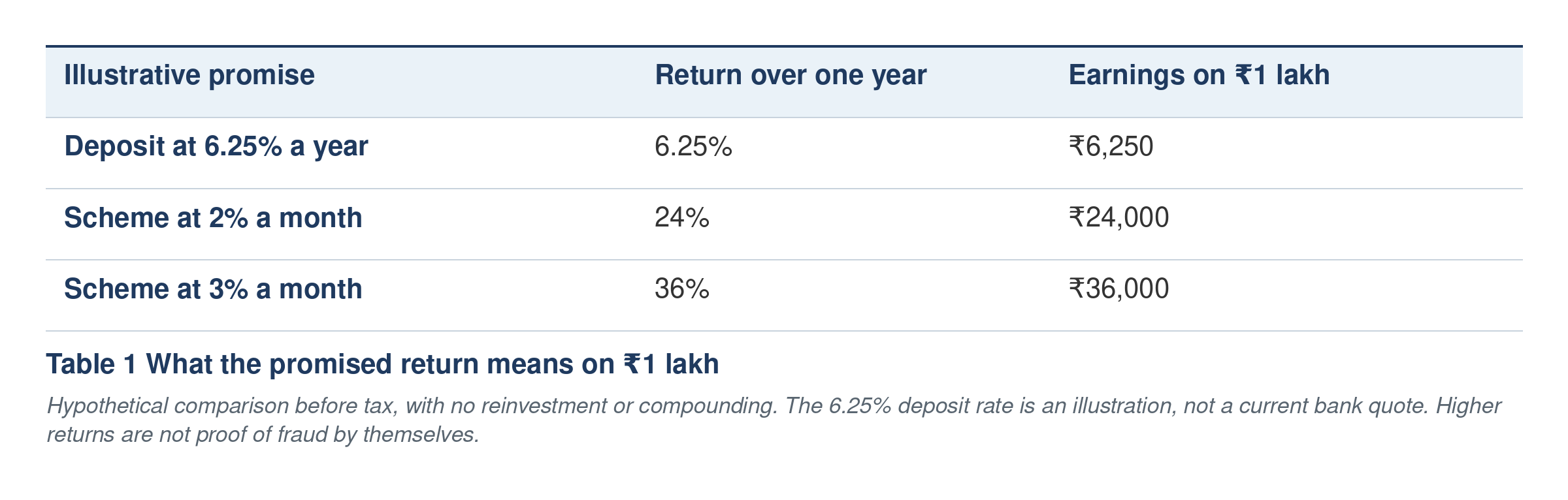
Some legitimate products pay a fixed return. The warning is an unusually high assured return backed by a profit story or permission you cannot verify. Bank deposits also have risks; eligible deposits have DICGC insurance only within its limits.
Understand why an early payment proves little
Suppose a promoter collects ₹10 crore and promises 3% a month. Monthly payouts alone are ₹30 lakh, or ₹3.6 crore a year, before expenses or returning anyone’s original investment. If there is no real income, those payments consume investors’ money.
Early payments help attract more investors. Friends may recommend the scheme honestly because they have been paid. When new money slows or many people ask to withdraw, the promoter may delay payments or demand fresh fees to release funds.
Check the claim behind the sales pitch
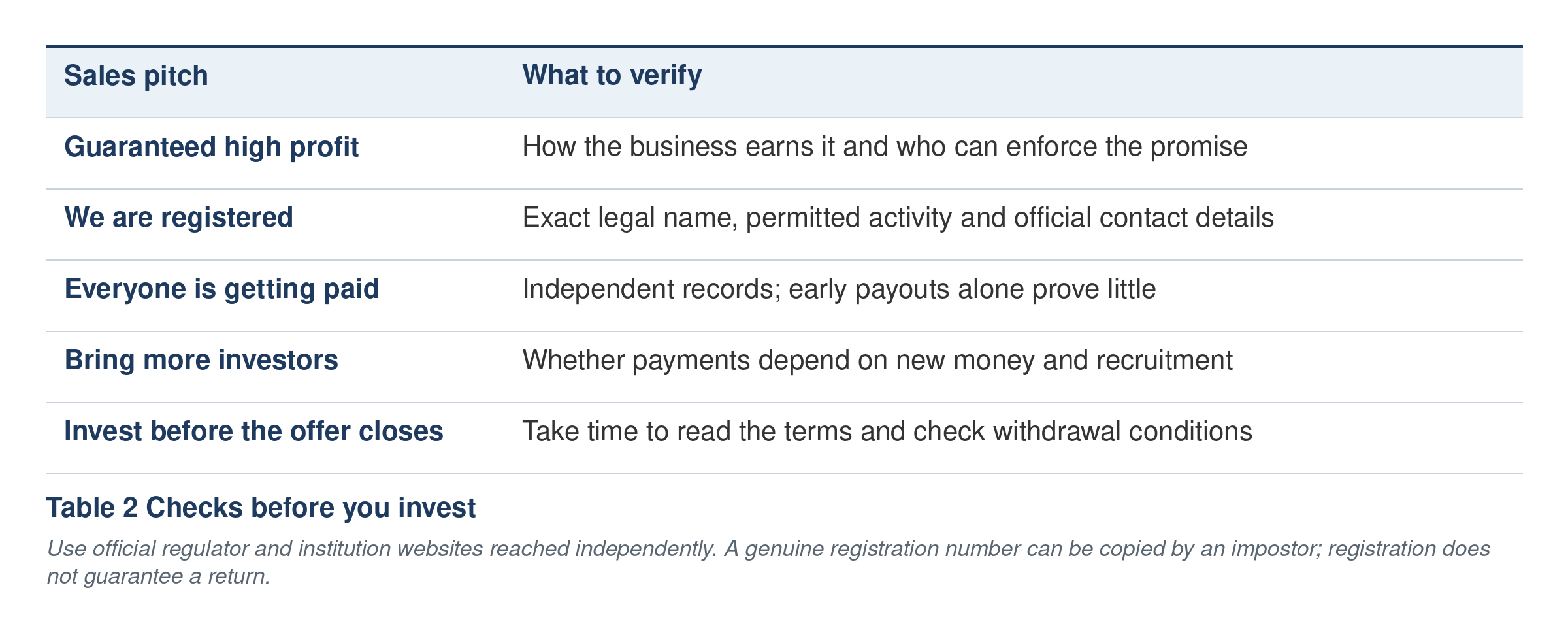
A registered investment adviser is not authorised simply by that registration to take deposits or promise assured market profits. Likewise, an RBI registration does not let every non-bank lender accept public deposits. Check permission for the actual activity, not just the company’s existence.
Keep Indian cases in perspective
In August 2014, SEBI ordered PACL to stop collecting money through its collective investment schemes, wind them up and refund investors. A collective investment scheme pools investors’ money. An unlawful pooled scheme and a Ponzi scheme are not automatically the same legal finding.
The Banning of Unregulated Deposit Schemes Act, 2019 prohibits unregulated deposit-taking schemes carried on as a business. Its definitions and exclusions matter. A company certificate, local office or familiar agent does not establish permission to run a deposit scheme.
Act if something does not add up
Do not send more money to unlock a withdrawal. Preserve the agreement, payment records and messages. Report suspected illegal deposit collection through Sachet and the relevant authority. For online financial fraud, contact your bank and 1930 immediately and use cybercrime.gov.in. Recovery can take time and is not assured.