Skip to content

Systematic Investment Plan (SIP)

A Systematic Investment Plan (SIP) allows an investor to invest a fixed amount in a mutual fund at regular intervals, usually every month.

Definition

A Systematic Investment Plan, or SIP, is a method of investing in a mutual fund through regular, fixed contributionsinstead of investing a large lump sum at once.

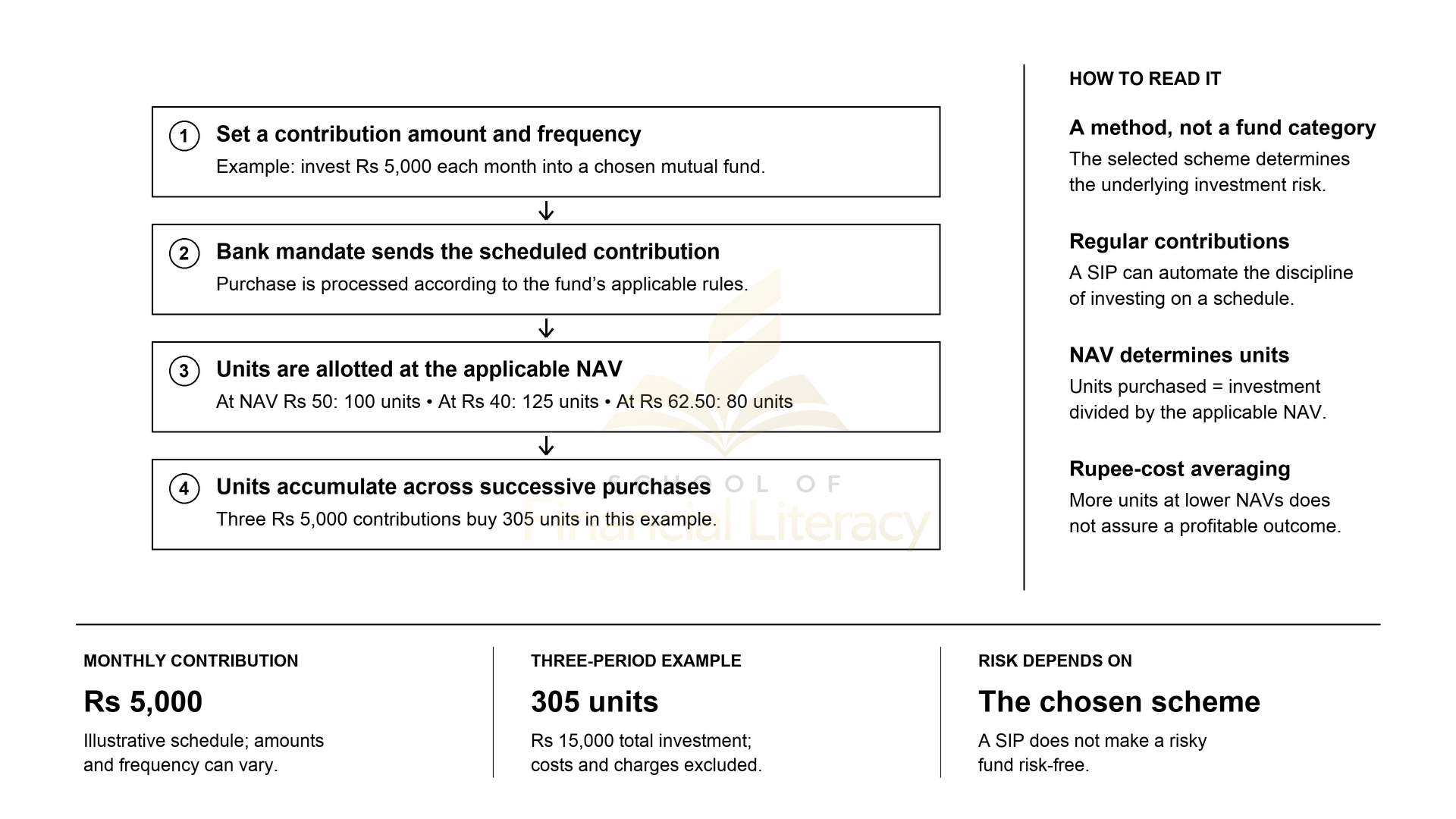
For example, an investor may invest ₹5,000 every month into an equity mutual fund. The amount is used to purchase units at the fund’s prevailing Net Asset Value (NAV).

When the NAV is lower, the same investment buys more units. When the NAV is higher, it buys fewer units. Over time, this can help average the purchase cost, although it does not guarantee profits.

SIPs are useful because they:

  • Encourage disciplined investing
  • Reduce the need to time the market
  • Make investing possible with smaller amounts
  • Support long-term financial goals
  • Can be automated through bank mandates

A SIP is only a method of investing, not a separate investment product. The risk still depends on the mutual fund chosen.

Returns are not guaranteed, and investors can still face losses if the underlying investments perform poorly.
Practical Example

Investing Monthly for a Long-Term Goal

Riya wants to build money for a goal that is 10 years away. She starts a ₹8,000 monthly SIP in a diversified equity mutual fund.

Some months, the market rises and she receives fewer units. During market corrections, the same ₹8,000 buys more units.

Instead of stopping when markets fall, she continues investing regularly.

Over several years, the SIP helps her build a sizeable investment gradually without having to decide the “perfect” time to invest. However, her final return still depends on the performance of the mutual fund and the time she remains invested.


Visual Example

History & Context

1990s–2000s

Growth of Regular Mutual Fund Investing in India

As India’s mutual fund industry expanded, fund houses increasingly promoted systematic investing as a practical way for retail investors to invest regularly.
2010s

Rapid Rise in SIP Adoption

Digital payments, online investing, and wider financial awareness made SIPs much more popular among Indian households.
Today

Major Retail Investing Method

SIPs are now widely used in India for long-term wealth creation, retirement, education, and other financial goals, especially through equity mutual funds.