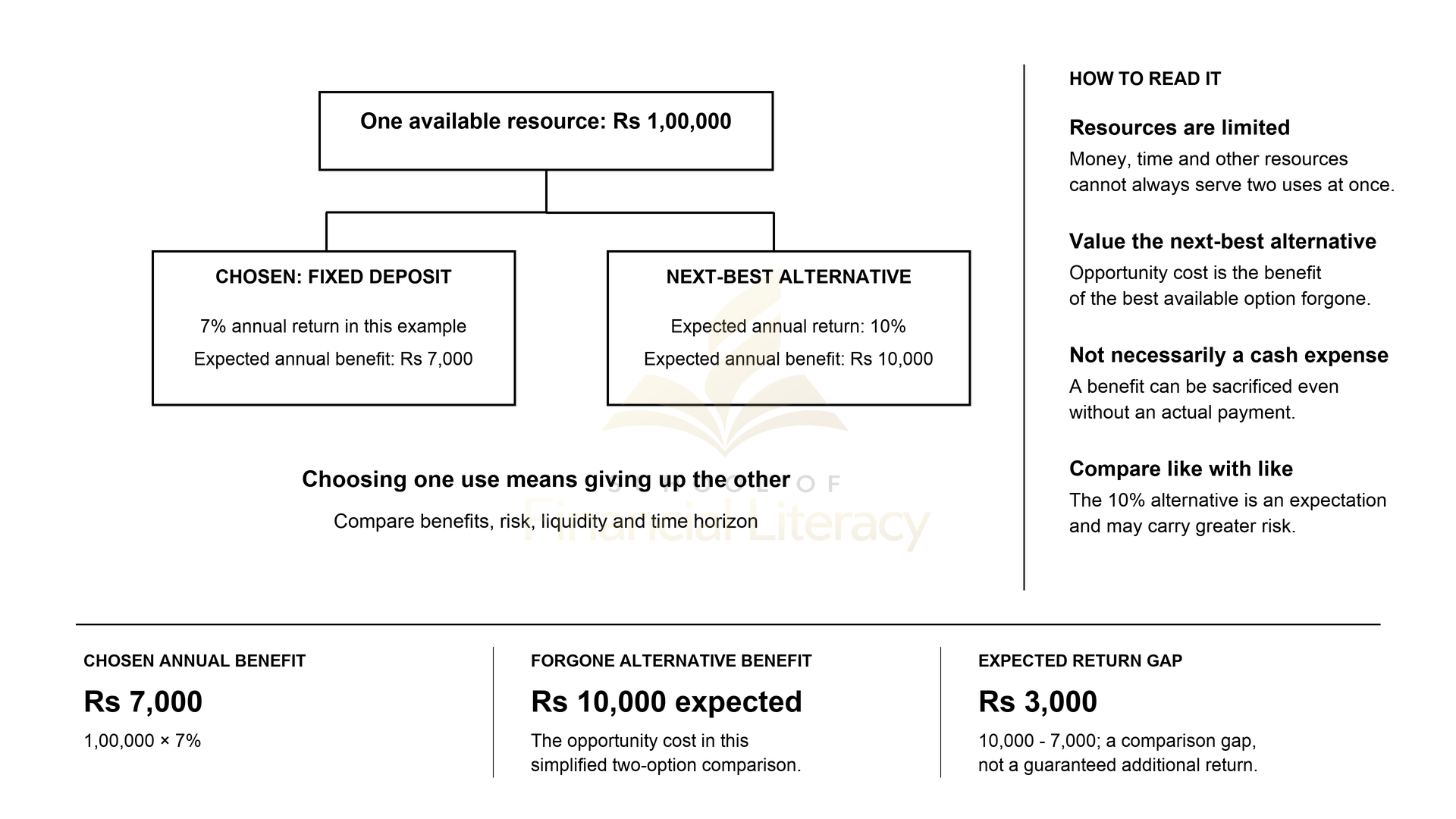
Opportunity Cost exists because resources such as money, time, labour, and capital are limited.
Whenever a choice is made, another possible use of those resources is usually sacrificed.
For example, suppose an investor has ₹1 lakh and can choose between:
- A fixed deposit earning 7% per year
- An investment expected to earn 10% per year
If the investor chooses the fixed deposit, the return from the alternative investment is given up.
In simplified terms, the potential difference is:
10% − 7% = 3%
That forgone additional return can be considered part of the Opportunity Cost of choosing the fixed deposit, although the alternative investment may also involve different risks.
Opportunity Cost applies to many economic and financial decisions, including:
- Investing money
- Choosing between employment and education
- Using land for different purposes
- Government spending decisions
- Business investment
- Saving versus consumption
For example, if a company spends ₹5 crore building a new factory, it cannot use the same ₹5 crore for another project at the same time.
The Opportunity Cost is therefore not necessarily an actual cash expense.
It represents the benefit sacrificed by choosing one alternative instead of the next-best available option.
Opportunity Cost is important because it encourages decision-makers to consider not only what they gain from a choice, but also what they give up.