Skip to content

Asset Allocation

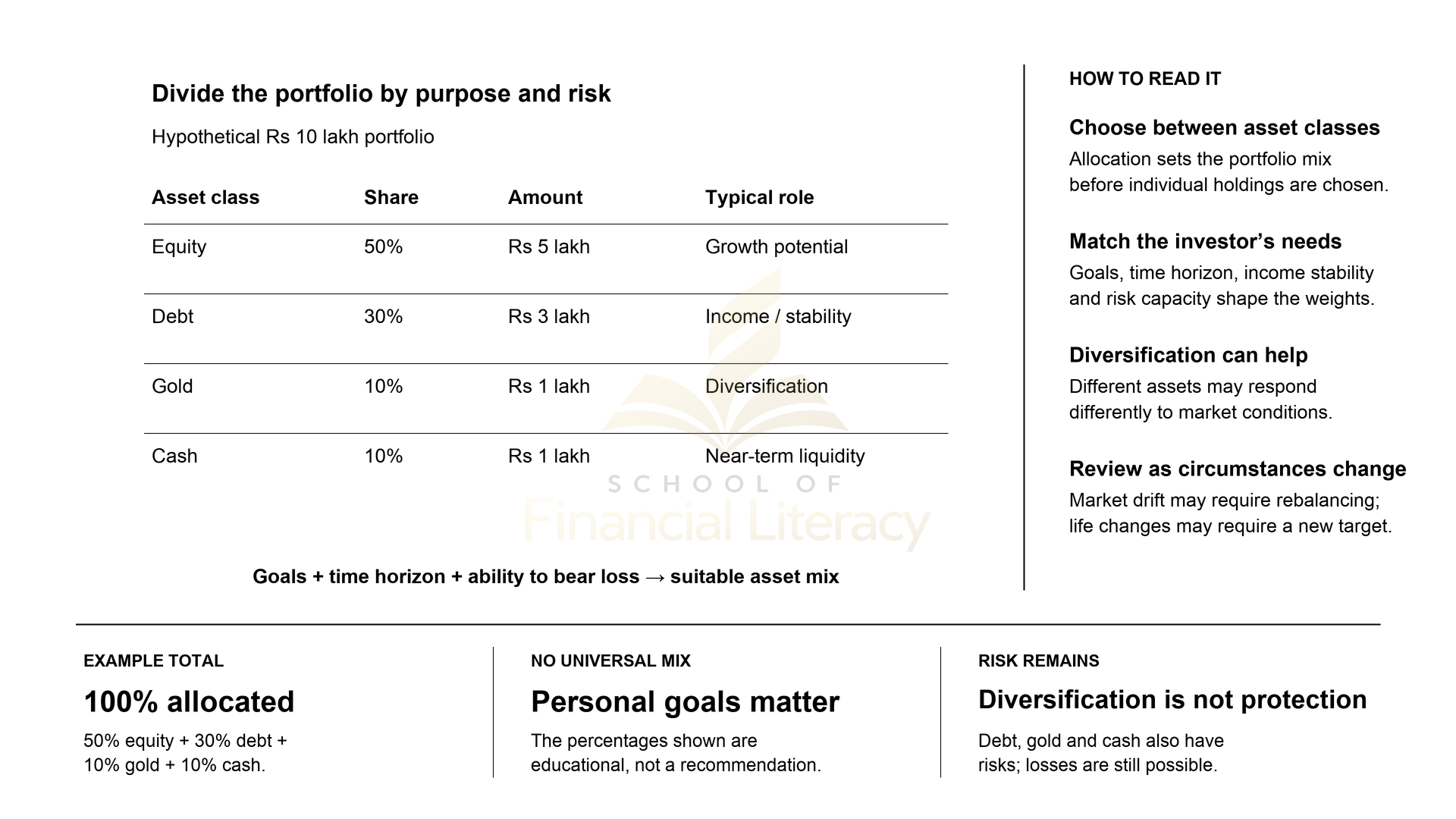
Asset allocation is the process of dividing investments across different asset classes, such as equity, debt, gold, and cash, to balance risk and return.

Definition

Asset allocation means deciding how much of a portfolio should be invested in different types of assets.

Common asset classes include:

  • Equity for long-term growth potential
  • Debt or fixed-income investments for stability and income
  • Gold or other commodities for diversification
  • Cash or liquid investments for short-term needs and emergencies

The right mix depends on factors such as an investor’s financial goals, time horizon, income stability, and ability to handle losses.

For example, a young investor saving for retirement several decades away may choose a higher allocation to equity. Someone approaching retirement may prefer a larger allocation to debt and other relatively stable assets.

Asset allocation matters because different asset classes do not always move in the same direction at the same time. A diversified mix can therefore reduce the impact of poor performance in any one area.

Over time, market movements can change the original allocation. Investors may then rebalance the portfolio by buying or selling assets to return to their desired mix.

Asset allocation does not eliminate risk. Instead, it helps ensure that the level and type of risk in the portfolio are aligned with the investor’s needs.
 

Practical Example

Building a Portfolio Around a Goal

Neha, age 32, is investing for retirement and has a long time horizon.

After considering her ability to tolerate market fluctuations, she decides to invest 70% in equity, 20% in debt, and 10% in gold.

A few years later, strong equity markets increase the equity portion to 80% of her portfolio. Neha rebalances by moving some money from equity into debt and gold.

This helps restore her original asset mix and prevents the portfolio from becoming more aggressive than she intended.


Visual Example

History & Context

1952

Modern Portfolio Theory Introduced

Economist Harry Markowitz published influential work showing how combining different assets could improve the balance between risk and expected return in a portfolio.
1970s–1990s

Asset Allocation Gains Wider Use

Institutional investors, pension funds, and investment advisers increasingly used structured asset-allocation approaches when building diversified portfolios.
Today

Core Principle of Portfolio Construction

Asset allocation remains one of the most important decisions in investing because it determines how much exposure a portfolio has to different sources of risk and return.